
DATA 047
GloPPRUA-Global harmonized urban definition/boundary/extent
Beijing City Lab Data
Type & Source This data is the global urban boundary of 222 scenarios combined by different population data sets, population density and population size thresholds, and the GIS model builder for calculating these data. See the README file for details. https://doi.org/10.6084/m9.figshare.28248101 The UN (United Nations) collects global data on the country-level Percentage of Population Residing in Urban Area (PPRUA); however, variations in definitions of urban areas make these data incomparable across countries. This paper evaluates the numbers of national defined PPRUA within UN statistics, by comparing them with...
Media / 图片视频
Source Images / 原始图片
Text / 正文
Type & Source
This data is the global urban boundary of 222 scenarios combined by different population data sets, population density and population size thresholds, and the GIS model builder for calculating these data. See the README file for details. https://doi.org/10.6084/m9.figshare.28248101
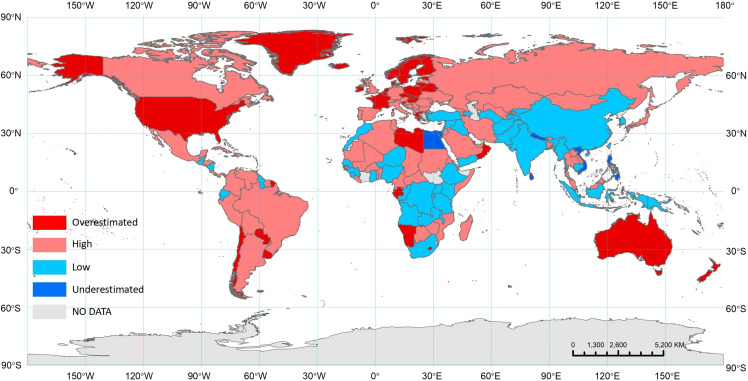
The UN (United Nations) collects global data on the country-level Percentage of Population Residing in Urban Area (PPRUA); however, variations in definitions of urban areas make these data incomparable across countries. This paper evaluates the numbers of national defined PPRUA within UN statistics, by comparing them with the numbers of PPRUA we estimated through global comparable definitions. Refer to the Degree of Urbanization framework from the UN, we propose 90 global harmonized methods to estimating PPRUA by combining different configurations of three global population datasets, six urban total population thresholds, and five urban population density thresholds. This approach demonstrated significant variations in country-level PPRUA estimations, with a wide 95% confidence interval (CI) range. When comparing the national defined PPRUA with the global harmonized estimations, we found that most lie between the upper 95% CI and the median of the estimations. This study highlights the need for globally harmonious PPRUA estimates, calling for a reassessment of datasets and thresholds in the future and investigating urbanization on a scale beyond the country level.
Citation
Li, W., Zhang, Y., Li, M., & Long, Y. (2024). Rethinking the country-level percentage of population residing in urban area with a global harmonized urban definition. iScience, 27(6), 110125. https://doi.org/10.1016/j.isci.2024.110125.
Access & Document
Downloads / 下载
Files / 附件下载
File
No downloadable file listed / 暂无可下载附件